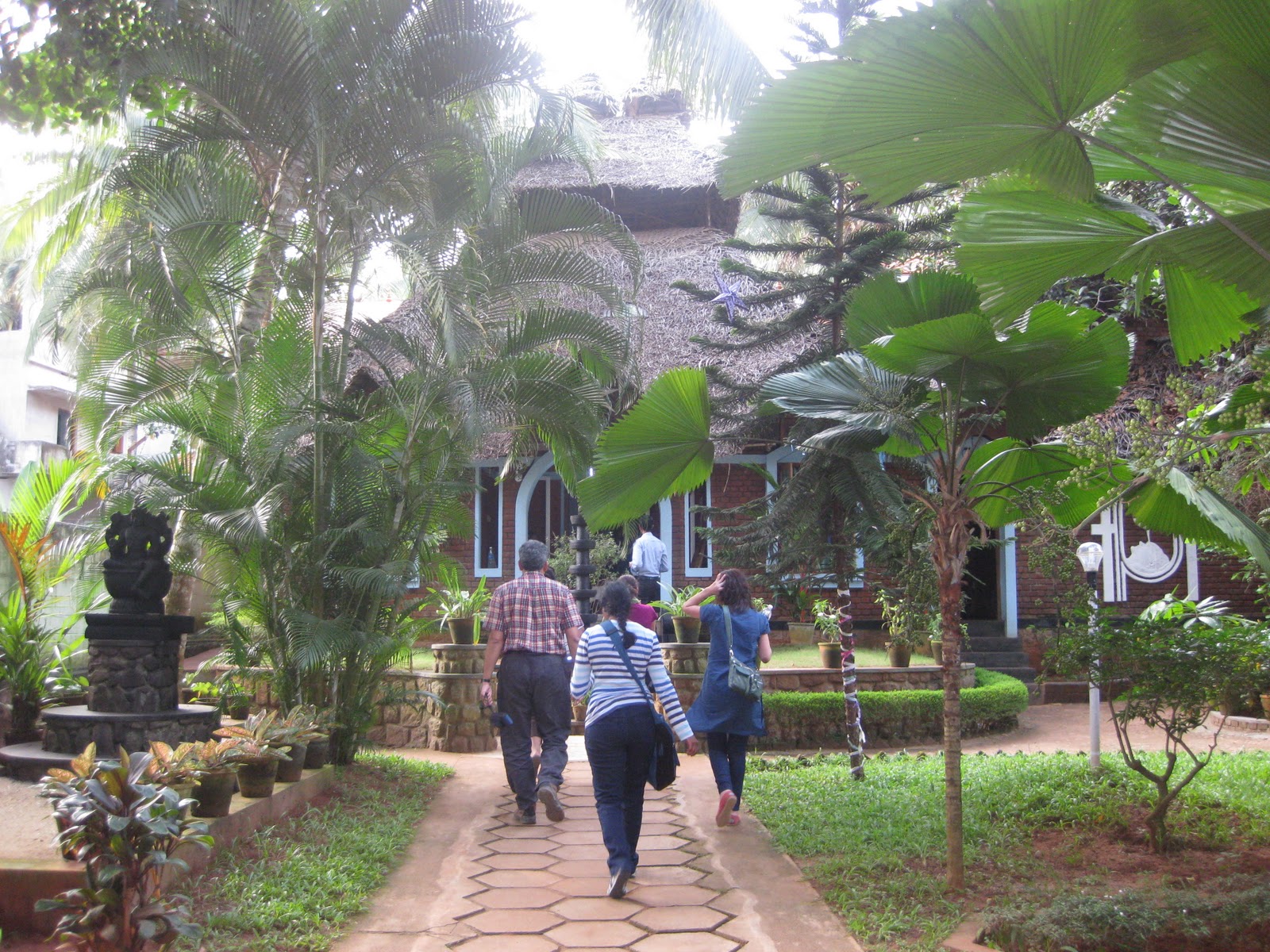
Today we toured a gorgeous residence designed by Laurie Baker. The house belonged to a teacher and a planner who hired Baker to custom design the home, which was absolutely beautiful. Baker, known for working onsite and without blueprints, spent an extraordinary amount of time designing this home. Our host told us stories of how Baker spent time getting to know her, her preferences, and personality before beginning to design. Most of us in the group agreed that we would love to live in a house like this! After our visit we packed into our van and traveled to a major port city in Kerala called Kochi. The most exciting moment of the trip is when we passed a man riding an elephant along the side of the road!
Monday, January 17, 2011

When we talk about community development, we talk about women and children
Day 9 of the trip focused on social planning and the role of gender in community development. We heard from staff of a government-funded program called Kudumbashree, which means “Prosperity to the Family,” followed by a feminist marxist critique of “the Kerala Model.”
Kudumbashree is a state run, locally administrated program funded by the People’s Plan Campaign. The People’s Plan was enacted after consitutional amendments in 1993, which required a more decentralized planning process, granting local governments more administrative power as well as a higher percentage of state budgets. These amendments also enacted a mandate to alleviate poverty and provide social services. This mandate is partially aimed at addressing the historic marginalization of women and other minority groups in the planning process. Local governments now mandate participation of women through a quota requiring a 50% female representative body. Furthermore, these new changes in policy ensure that women participate in task forces and working groups and have thereby helped to bring women into the new decentralized planning process. The Women’s Component Plan has become an essential element to the anti-poverty plan. Changes to the planning process in India due to the 1993 and 1994 constitutional amendments was a constant theme throughout all of our lectures on the trip.
The mission of Kudumbashree is “to eradicate absolute poverty in ten years through concerted community action under the leadership of local governments, by facilitating organization of poor for combining self help…” The agency coordinates various socio-economic development programs ranging from micro-credit financing to food security and nutrition needs.
The program that I found most interesting was their “women status self-learning program.” Staff found that while women were bringing in extra income and learning valuable skills as a result of the micro credit program, the program did not address other gender-related problems. Domestic violence, barriers in the workforce, and the problem of dowries are still prevalent. According to the presenter, Sarada Muraleedharan, it was not enough that women get space within the public process, they need a voice as well. Kudumbashree provides relevant literature and facilitates discussion on topics primarily pertaining to women and work such as equal wage remunerations, women and safety in the work place, and health concerns at work.
Muralledharan noted that since most literature on gender comes from outside of India so one thing the agency has done is to make the material relevant to Indian women by creating stories or newspapers. The program has been so successful that it caught the attention of national government and there is currently talk to expand the model to other states.
In the afternoon, Nalini Nayak from the Self Employed Women’s Association (SEWA) presented a critique of the Kerala Model. She dissected women’s status in Kerala and took a closer look at the claims to women’s progress in the state. For example, while women have made strides in education, there is a higher child mortality rate among girls than boys and gendered segregation in the professions is also evident. Such inequalities or disparities are usually less obvious and therefore more difficult to address. The same phenomenon happens in the U.S.
Both presentations provided me with a better understanding of programs and perspectives related to gender in Kerala. It is encouraging to see this dialogue take place among government officials and everyday people. One thing is clear, we are certain to see great things from Indian women now and in the future.
Town Planning in India
During the eighth day of the trip we heard from a planner named Mr. Kasthuri Rangan. His presentation provided us with an overview of planning in India, Kerala, and Trivandrum. Mr. Rangan shared many insights and useful perspectives on planning. I learned that planning in India is a growing field and will provide many exciting opportunities. People seem energized about planning here and a sense of responsibility and eagerness to bring about social, economic, and environmental progress is evident.
Some basics about planning in India: the Central Planning Commission sets the national agenda, which is then reflected in state plans. States then develop a five-year plan that combines both national and state priorities. Local governments are responsible for spatial planning and receive one third of the state’s financial resources. Local governments also develop their own plans. Master plans for cities or townships reflect both state and national priorities in addition to local needs.
What Mr. Rangan stresses is the fact that plans should be dynamic because is impossible to literally translate plans on the ground. Instead, plans should include a framework for land use and social planning in the form of policies, expectations, needs, and goals. Every city has to evolve its own land use strategies and proposes a “systems approach to planning.” According to Mr. Rangan, it is the planner’s task to bring various sectors together and systematically integrate knowledge applicable to planning. I believe that many of the points Mr. Rangan discussed in regards to planning in India also are applicable to planning in the U.S.
Thursday, January 6, 2011
"We need to be the change we wish to see in the world" - Gandhi
During day 6 of our trip, we visited Laurie Baker's residence known as the "Hamlet." Most of the COSTFORD staff members based in Trivandrum work out of the residence. Baker's wife, Elizabeth Baker, still lives there. Laurie and Elizabeth Baker certainly fulfilled Gandhi's philosophy that "we need to be the change we wish to see in the world."
After lunch we took a tour of a residence designed by COSTFORD and heard a presentation by the resident, Merle Kindred. Kindred is a Canadian born, American raised scholar who recently moved to Kerala. Her research includes examining communication challenges in regards to energy change. During her dissertation research, Kindred took a trip to India and realized that the people she met here would be the ones who suffer the most from global climate change yet they are not the ones responsible for it. This was one of her motivations for coming to India. She is now an independent consultant and presenter who is helping to get the word out about COSTFORD and Baker.
On day 7 we visited the Mithraniketan campus. Mithraniketan, which means "Home of Friends," is a grade school and high school. The campus also houses a People's College. The speaker spoke about the importance of sustainable, low-cost, environmentally sensitive architecture. While he sees a positive effect on educating young people about this message, he also has serious doubts. Young architects come to the campus, take up this type of work for a little while, then switch to designing conventional buildings that bring in more profit. During a particularly moving part of his talk, he said "I am helpless. No one will listen to me." While he hopes for a breakthrough in eco-sensitive cost-effective architecture and technologies, he is discouraged. People are starting to live in larger houses even though families are getting smaller. He also spoke about challenges that the school is facing including funding and retention of teachers and social workers who often leave Mithraniketan for higher paying jobs.
Today I had my first ayurvedic massage and boy was it an experience. The massage was very therapeutic and felt amazing. I definitely felt out of my comfort zone at first as we had to practically strip down in front of a complete stranger! There was a whole lot of coconut oil involved and I came out of the massage looking very shiny! It was very relaxing and any worries or stress that I had just melted away.
After the massage, we went to dinner followed by dessert at a local bakery. As most of you probably already know, I have a big sweet tooth so very much enjoyed the bakery excursion. We took a rickshaw back to the hotel for the final thrill of the day. Overall, today was a nice, relaxing day. After all we have been doing this past week it was time to slow down the pace a little. I'm looking forward to the music festival we will be attending tomorrow. Oh, and it will be hosted by the Travancore Royal Family. Hopefully I will get to see the prince!
 |
| Milini at "the Hamlet" |
 |
| Wall flower |
 |
| View from a terrace at "the Hamlet" |
 |
| Dog house at "the Hamlet" |
After lunch we took a tour of a residence designed by COSTFORD and heard a presentation by the resident, Merle Kindred. Kindred is a Canadian born, American raised scholar who recently moved to Kerala. Her research includes examining communication challenges in regards to energy change. During her dissertation research, Kindred took a trip to India and realized that the people she met here would be the ones who suffer the most from global climate change yet they are not the ones responsible for it. This was one of her motivations for coming to India. She is now an independent consultant and presenter who is helping to get the word out about COSTFORD and Baker.
 |
| Merle Kindred's residence designed by COSTFORD |
We also visited a rural area and met with local officials of the Aryanad Panchayat (local form of government). They showed us several local initiatives including women's agricultural cooperative, a school (with many eager children waiting to meet us), and a locally run library.
 |
| agricultural site for a local women's cooperative |
 |
| books at the local public library |
 |
Fresh bread at the 'pure veg' bakery |
 |
| Monkey statue at Mithraniketan |
Today I had my first ayurvedic massage and boy was it an experience. The massage was very therapeutic and felt amazing. I definitely felt out of my comfort zone at first as we had to practically strip down in front of a complete stranger! There was a whole lot of coconut oil involved and I came out of the massage looking very shiny! It was very relaxing and any worries or stress that I had just melted away.
 |
| on our way to get our massage |
 |
| logo - oil being poured on a person's head |
After the massage, we went to dinner followed by dessert at a local bakery. As most of you probably already know, I have a big sweet tooth so very much enjoyed the bakery excursion. We took a rickshaw back to the hotel for the final thrill of the day. Overall, today was a nice, relaxing day. After all we have been doing this past week it was time to slow down the pace a little. I'm looking forward to the music festival we will be attending tomorrow. Oh, and it will be hosted by the Travancore Royal Family. Hopefully I will get to see the prince!
 |
| Baked goods: sweet, fresh, and delicious |
Monday, January 3, 2011
Arise, Awake, and Stop Not til the Goal is Reached!
For our first weekend in India we travelled to Kerala's neighboring state, Tamilnadu. We first visited Padmanabhapuram Palace, which belongs to the state of Kerala but is geographically located within Tamilnadu. We then traveled to the city of Kanyakumari where we visited the monument of Vivekananda kendra, a well known and influential religious philosopher.
The contrasts between the two states was stark. Right away I noticed more poverty in Tamilnadu; more children were begging for money, more children were unclothed, people were squatting in places with no shelter, and people did not look as healthy as they did in Kerala. While walking through an area where squatters settled, one child came up and took my water bottle. He begged until I let go. It was a very sad sight. My feelings about the excursion are mixed. It was difficult to emotionally navigate the experience because in one moment I am marveling at a 500 year old palace and the next moment I am witnessing extreme poverty.
Photos of Padmanabhapuram Palace:
 |
| Padmanabhapuram Palace |
 |
| A view from within Padmanabhapuram Palace |
 |
| Me in my new outfit at Padmanabhapuram Palace |
 |
| Another view from a terrace within Padmanabhapuram Palace |
 |
| Columns at Padmanabhapuram Palace |
 |
| My professor, Dr. Jerry Anthony, sharing his wealth of knowledge. He spent 3 months during his undergraduate studies in architecture documenting the palace. |
 |
| more Padmanabhapuram |
 |
| The ladies bath at Padmanabhapuram Palace |
 |
| Milini and me cooling down with some refreshing coconut water |
Photos of Kanyakumari and Vivekandanda Monument:
 |
| Kanyakumari, the most southern tip of the Indian subcontinent |
 |
| A view of Vivekananda Monument from land, before boarding the ferry |
 |
| Another view of Vivekananda Monument |
 |
| Vivekananda Monument |
There is so much I wish I had time to write about but the photos will have to do for now. Our travel back to Trinandrum was long and rough. We were exhausted by the time we got back. I'm rested now and ready for another day. Thanks for reading my post!
Day 3: Laurie Baker Center, SEWA, and IISE
Day three of our journey was spent at the Laurie Baker Center for Habitat Studies (LBC). The facilities were gorgeous. This site was the last thing Baker designed before he passed away and its purpose is to document the work of COSTFORD and educate others about the organization's philosophy, goals, and methods. Our presentations covered Baker's philosophy and architectural style and low-cost and eco-sensitive materials and technologies.
 |
| Laurie Baker Center |
 |
| More LBC |
 |
| Mango Ying Yang |
 |
| Water Well at the LBC |
 |
| Homegirls at the LBC |
 |
| Human Mango |
 |
| Me getting ready to chow down! |
 |
| Traditional Kerala meal |
 |
| Women making paper at the SEWA |
 |
| Hand made paper dried and pressed |
The last place we visited was the International Institute for Social Entrepreneurs (IISE). Not only was the mission and story of the organization inspiring and touching, the IISE campus was breathtaking and progressive. The goal of the organization is to take the facilities off the grid and eventually become self-sustaining with no need for outside electricity.
 |
| A view of the outdoor classroom at the IISE |
 |
| A building at the IISE |
 |
| Coconut Trees! |
 |
| An interior view of the IISE facilities |
Saturday, January 1, 2011
Happy New Year!
It's 2011! The past two days have been filled with tons of activity. We rang in the new year at a resort on Kovalam Beach and I finally got to see and feel the Arabian Sea! We watched cultural performances, had dinner, took a walk on the beach, and danced under the stars and fireworks. It was pretty awesome.
We spent most of the day at Mithraniketan, home of COSTFORD, learning about the architectural styles of Laurie Baker and the organization's philosophical approach to low-cost, eco-sensitive housing.
 |
| Mithraniketan |
 |
| Tea time |
 |
| Shailaja Nair |
We also took a site visit to Karimadom, which is a slum that COSTFORD is working to rehabilitate. The current approach being taken to deal with slums in Kerala is rehabilitation, a stark contrast to (failed) attempts at slum eradication that were common in the past. Photos of Karimadom show part of the slum that has not yet undergone redevelopment as well as the new residential units that COSTFORD designed. Phase one of the redevelopment project has been completed and phase two is about to begin. Eventually, the entire slum of Karimodom will look like the COSTFORD buildings. We actually went inside one of the units and although very small, they were homey, individualized with painted walls and other personal touches, and most importantly, were a huge improvement to the residences' prior living situation. Many children were in Karimodom and they were very friendly, requesting that we take photos of them, asking our names, and following us around. One thing that we all noticed was how happy they seemed despite their situation. The woman who's home we visited expressed how pleased she was with her home. One thing that stood out to me about this project was how special and fun the buildings were. Even though they are low-cost, the architectural style of COSTFORD is so interesting.
 |
| Existing slum residences in Karimodom |
 |
| Rehabilitated residential units in Karimodom |
 |
| Phase 1 of Karimodom |
 |
| Phase 1 of Karimodom in forefront |
Tomorrow we will travel to Padmanabhapuram Palace and to Kanyakumari, where we will stay the night. We won't be back to Thiruvananthapuram (the official spelling and pronunciation of Trivandrum, which is the British colonial version of the name) until January 3rd. I may not have internet access until then so it may be a few days before I post an update. Namaskaram.
Subscribe to:
Posts (Atom)